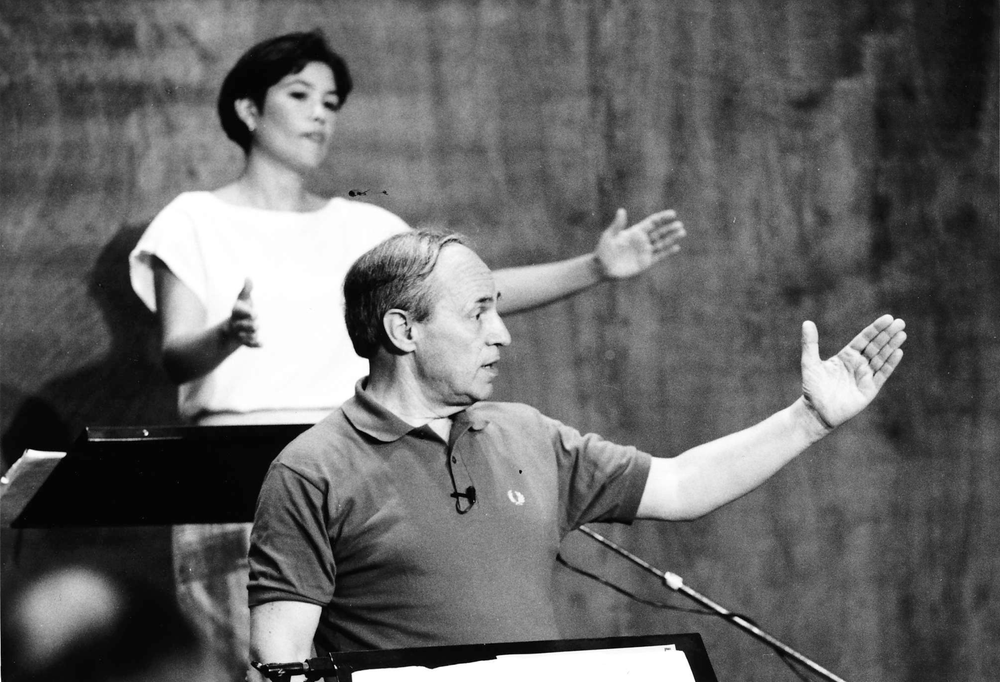
Boulez Demeure
A while ago,
energetic,
I practiced intensive container gardening
and raised compost worms—
red wigglers.
I read that everything—
granite, plants,
and all the rest—
once passed through
the tracts of ancient beings.
In the wolf-hour
they churned,
munching rotting garbage,
writhing in their bin—
I heard them!
Soft crunching persistence
produced compost,
ecologically correct
black gold,
that made my garden
sing.
Stiller,
today,
my thoughts crawl elsewhere—
to Joseph’s last seminar,
when he spoke
of Mendelssohn,
Levinas, Heidegger:
Each of us
dies
one death,
alone.
No one can compare.
So why all the chatter?
When I conducted
Mozart
and Bruckner
and Mahler
and Pagh-Paan,
didn’t I bring
night-stars
into the concert air?
Worms are memory.
On my zafu,
I prepare.
Alone.
Shall I still cry?
When I’m in the ground
the tunes I sang
will pass through the bellies
of those red wigglers—
like all the rest.
Pierre Boulez,
my cher mâitre,
You steadied
my trembling hands.
Author’s Note
Boulez Demeure takes its point of departure from listening. The poem is shaped by structural hearing, remaining with sound as it unfolds in time, attentive to sequence, duration, and return.
Written in 2011 as a memorial to a great artist, it arose from long engagement with musical practice and structural listening. Form remains alert to timing and spacing. Meaning emerges through relation — the exact placing of elements within time.
The poem does not expand into lyric tribute; its language is pared back. It resists ornament and explanation. Exactness matters: the discipline of staying with what is given, without consolation.
Years later, in the context of Zen practice and reflection on life-death (shōji), a further implication became visible: continuity not as concept but as condition. What had been approached through musical discipline disclosed itself as a meditation on dwelling — remaining in time without seeking release from it.
Placed within Legacy, Boulez Demeure stands as a position shaped by long practice: listening, staying, recognizing life-and-death as continuous field rather than event. What persists is not resolution, but continuity.
Deutsch
Boulez Demeure nimmt seinen Ausgang im Hören.
Das Gedicht ist von strukturellem Hören geprägt und bleibt beim Klang, wie er sich in der Zeit entfaltet — aufmerksam für Abfolge, Dauer und Wiederkehr.
2011 als Gedenktext für einen großen Künstler geschrieben, entstand es aus langjähriger Auseinandersetzung mit musikalischer Praxis und strukturellem Hören. Die Form bleibt wach für Timing und Abstände. Bedeutung entsteht durch Relation — durch die genaue Platzierung der Elemente in der Zeit.
Das Gedicht weitet sich nicht zur lyrischen Würdigung aus; seine Sprache ist zurückgenommen. Es widersteht Ornament und Erklärung. Genauigkeit zählt: die Disziplin, beim Gegebenen zu bleiben — ohne Trost.
Jahre später, im Zusammenhang mit Zen-Praxis und der Reflexion auf Leben-und-Tod (shōji), wurde eine weitere Implikation sichtbar: Kontinuität nicht als Begriff, sondern als Bedingung. Was durch musikalische Disziplin angenähert worden war, erwies sich als Meditation über Verweilen — als Bleiben in der Zeit ohne das Suchen nach Befreiung.
Innerhalb von Legacy steht Boulez Demeure als Position, geformt durch lange Praxis: hören, bleiben, Leben-und-Tod als kontinuierliches Feld erkennen statt als Ereignis. Was bleibt, ist nicht Auflösung, sondern Kontinuität.
Photo courtesy of Guy Vivien